Found 12 results

Teleslides- Cinema Advertising Slide

Cinema advertising was big business in the 1950s and early 1960s when over thirty million tickets were sold each year. The sales of advertising made up around 2%-5% of a cinema's profits- but they meant much more to the cinema managers who got commission on each ad sold. Managers were often seen around town visiting shops to sign owners up to an advertising package. Free tickets to a popular film were often supplied to sweeten the deal. 

Even projectionists got a piece of the action as the advertising slide companies (often owned by the cinema chains themselves)  paid a yearly bonus to make up for the hassle of screening dozens of slides with every film. The assistant projectionist who was delegated this job usually was none the wiser about this bonus.

But by the 1970s the gloss was coming off cinema advertising. The commission given to managers was reduced to a small bonus. Local radio was able to change ads on short notice, unlike cinema advertising slides which took weeks to be made and approved. Audience numbers were falling in the face of television and a new culture of going to see a particular film and not visiting the cinema  anyway and seeing what was on. 

Teleslides was the last gasp of the cinema advertising slide. These were static images projected onto the screen but with a few seconds of audio played through the speakers. The audio for all slides were put onto a vinyl record but it was up to the projectionist to make sure they kept changing the pictures in sync with the words. The slide screenings sometimes became unintentional comedy for the audience!

By the end of the 1970s the era of the advertising slide was all but gone. They were replaced by reels of motion picture film advertising businesses instead.


Frost Motors Limited- Cinema Advertising Slide

This dealership was owned by none other than Ron Frost, a New Zealand motorsport legend who not only raced cars in Levin and around the country but who also organised races and attracted new motorsport talent to New Zealand.

Ron Frost was born in England and served in the British Army during the Second World War- including many years as a POW until he escaped a German prisoner of war camp in 1945.

Frost Motors started out selling new cars from the Rootes group (including Hillmans, Humbers and Sunbeams) but they later opened a used car yard near their first location. The new car showrooms and petrol pumps were on Oxford Street South. The used car lot was on Oxford Street North. The business remained in the family until the late 1970s.

There is a wealth of knowledge about Ron Frost online.

The car on the slide has a number plate which reads '1966' which is a great indication of when this slide was made! 

Foxton Shoe Company- Cinema Advertising Slide (2)

 Records on Kete Horowhenua show the Foxton Shoe Company located on Main Street in 1950 and 1955 (but it may have existed before and after those dates). They were located just to the right of the Whyte Street intersection (from the perspective of Whyte Street). 

For those who think 'back to school sales' are a recent development this slide proves otherwise! The school uniform dates this ad to the 1950s (as does the satchel- no 'school bags' here...). Up until 1952 the Foxton District High School was located near the end of Main Street next to Ihakara Gardens. These buildings were still used for some secondary and primary classes for the rest of the decade. 

The students would not have had to walk far to get new shoes or see a film- Coronation Hall Cinema was located just a minute's walk from the school gates.

Possum Bounty- Cinema Advertising Slide

Possums are a massive problem in New Zealand. Today, over 30 million of the mammals eat through around 9000 tonnes of vegetation a night. This bounty scheme from 1951 was the first large scale attempt to control the pests. Hunters brought in the possums ears and a strip of fur to claim their two shillings and sixpence bounty. Eight million such bounties were claimed in the ten years the scheme ran.

But the plan was failure. Three quarters of the possums 'killed' were found on farms, near towns or even as roadkill on the highways. Few were caught in the forests where the greatest need was. When the scheme began, possums occupied just over half of the country. When it ended, over three quarters of Aotearoa had possums. Hardly the mark of success!

This slide was shown in Paraparaumu cinemas- but slides just like it would have also been screened in Horowhenua. Note the mistake in calling the animals 'Opossums'- these are the American marsupials, but the name was commonly used here! 

K. Hager and Co. Ltd- Cinema Advertising Slide

Cinema advertising slides promoted products, services, events and government messages- but advertising situations vacant is a much rarer sub-section of slides.

K. Hager and Co. Ltd made clothing- with a 1958 newspaper ad for new staff suggesting they specialised in shirts and blouses. At the time the company boasted fifty staff on the payroll in their Levin-based factory.

An online records search suggest that this company was established in 1956 and deregistered in 1993.

Te Papa has a collection of advertisements by K. Hager and Co. showing the latest 1970s styles. The firm doesn't exist anymore but they sure knew how to advertise to the flower power generation! You can see these ads by following this link.  https://collections.tepapa.govt.nz/agent/31790

S. Mattar- Cinema Advertising Slide (2)

 There is some uncertainty about the location of this business- but we do know something about  'S.Mattar'. Kete records show an 'S. Mattar' trading on Main Street as a draper in 1930 (in 1932 identified as the 'Kosy Cash Drapery'). 1937 saw him selling golfing supplies on Foxton's Main Street. In 1945 an 'S. Matter' was trading as a hairdresser alongside tobacconist 'L. Matter' on Foxton's Main Street (near the intersection with Whyte Street). 

By 1950 'L. Matter' was carrying on business as a hairdresser and tobacconist alone. In the  MANAWATU TIMES, VOLUME LVI, ISSUE 5588, 28 FEBRUARY 1931, PAGE 2  an 'S. Mattar' was part of a team who retained a bowling title. Did 'S. Mattar' have a shop of his own? Or was he part of a broader family business? 

This is one of multiple slides from this business searchable on Kete. This one advertises Gillette razors. The 'Blue Blade' razor was introduced in the early 1930s- however this slide looks to be a lot later than this. The date is only a vague estimation on this one!

R.N Spiers LTD- Cinema Advertising Slide

R.N Spiers, who feature in other MAVtech cinema slides as a timber merchant, have been recorded on Foxton's Main Street as far back as 1905 and as recently as the early 1960s. It seems that they also sold ovens as well!

The 'Champion Commodore' was named after a senior navy rank (the former Holden car having the same background). A navy officer is seen, slightly out of focus, behind the women in this slide. 

'Radiation (N.Z.) Ltd' made whiteware goods  and a 'Champion' range of kitchen appliances  was in stores from the 1920s up until the 1970s according to online records. A price list for Champion stoves from 1961 has been recorded. 

The allure of automatic cooking was front and centre with this ad- 'just set it and forget it!'

D.A. Blackburn - Cinema Advertising Slide

In the middle of the 20th century the high streets of small town New Zealand were full of specialized businesses and crafts which today are only found in the main centres. Take D.A. Blackburn- a repairer of watches located on Foxton's Main Street. 

Before the arrival of cheaper watches which are easier to replace than repair, there were many such craftspeople in business. However- maybe Blackburn was too specialized for a town of Foxton's size. Kete records show him in business in 1960 but not in 1955 or 1965, so his shop didn't last as long as many others who took out cinema advertising in Foxton.

Blackburn also sold watches and clocks- all tested and guaranteed! 

Levin Auctioneering Co. Ltd Cinema Advertising Slide

From antiques to furniture a trip to the auctioneers was the offline version of popular internet auction sites. This company also took out paper advertising which can be seen on Kete Horowhenua (https://horowhenua.kete.net.nz/item/9d7d6049-c491-45ac-8c35-3a2b02e6c830) but they were then in a different location and under a different auctioneer. The printed advert was from the 1950s- it is believed that this slide was made later.

Unlike a newspaper which was read by one person at a time, a cinema slide was projected at the end of a film's intermission (later, when intermissions fell out of favour, they were often screened before the film began). The projectionist had to display and remove the slide in a few seconds- otherwise the heat from the projector's lamp would crack the glass!

Becoming a projectionist took around five years of on the job training- and preparing the advertising slides was one of the first jobs a trainee was entrusted with. Just don't crack the slides.....

Cinema Slide Storage Boxes

These boxes were sent to the managers of local theatres decades (in one case even around a century) ago! In them were slides promoting upcoming films which were projected onscreen during the intermission.

From the 1910s big cinema chains began appearing in New Zealand and they competed for the rights to show overseas releases. At a time when a town Foxton's size had two cinemas this differentiation was important for business. 

Some of these boxes bear the names of Aotearoa's big cinema names like 'Kerridge'. The 'Pacer-Kerridge' alliance was founded in 1987 making the upper left box the newest of the assortment seen here. By contrast, the Paramount logo seen here was phased out in 1967! 

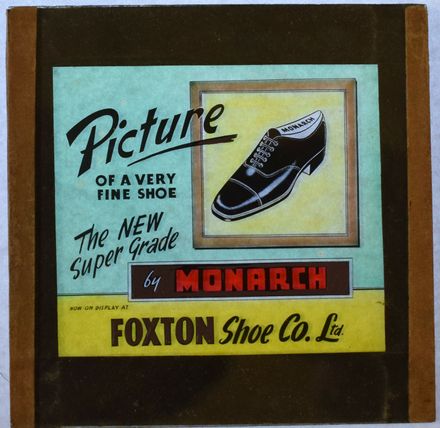
Foxton Shoe Company- Cinema Advertising Slide

Records on Kete Horowhenua show the Foxton Shoe Company located on Main Street in 1950 and 1955 (but it may have existed before and after those dates). They were located just to the right of the Whyte Street intersection (from the perspective of Whyte Street).

In a time when many jobs required a suit, having a fine pair of shoes like this was a must. This slide would have been shown in Foxton cinemas in the 1950s (most likely during intermission). Cinema advertising was popular with local businesses due to it's low cost and with around forty million cinema tickets being sold per year at the time these ads had reach! 

MAVtech's collection of advertising slides provide a glimpse into many businesses which have long disappeared. How many small towns today have a specialist shoe shop? 

Scotts Drapery LTD Foxton- Cinema Advertising Slide

Kete Horowhenua records show that Scotts Drapery was in Foxton's Main Street in 1960 but that it had closed by 1970. When it traded it gave small town New Zealand the chance to buy fashions from Australia and even California! With memories of the US Marines from the World War Two still in many people's minds, American fashions were seen as very stylish indeed.

Cinema advertising was cheap to utilise and a small business could target local theatres making it very effective. With colour film expensive to buy and process hand colouring was also in fashion! 

Imagine audiences returning to their seats during the intermission of some exciting American film seeing their chance to buy the fashions that they saw onscreen. It's a wonder Scott's Drapery didn't last longer!

Search settings