
Shannon - Farming, Volunteers & Conscription
- Description
-

Left: Photograph (taken about 1918) of the Shannon branch of the Bank of New Zealand building, constructed in 1913.
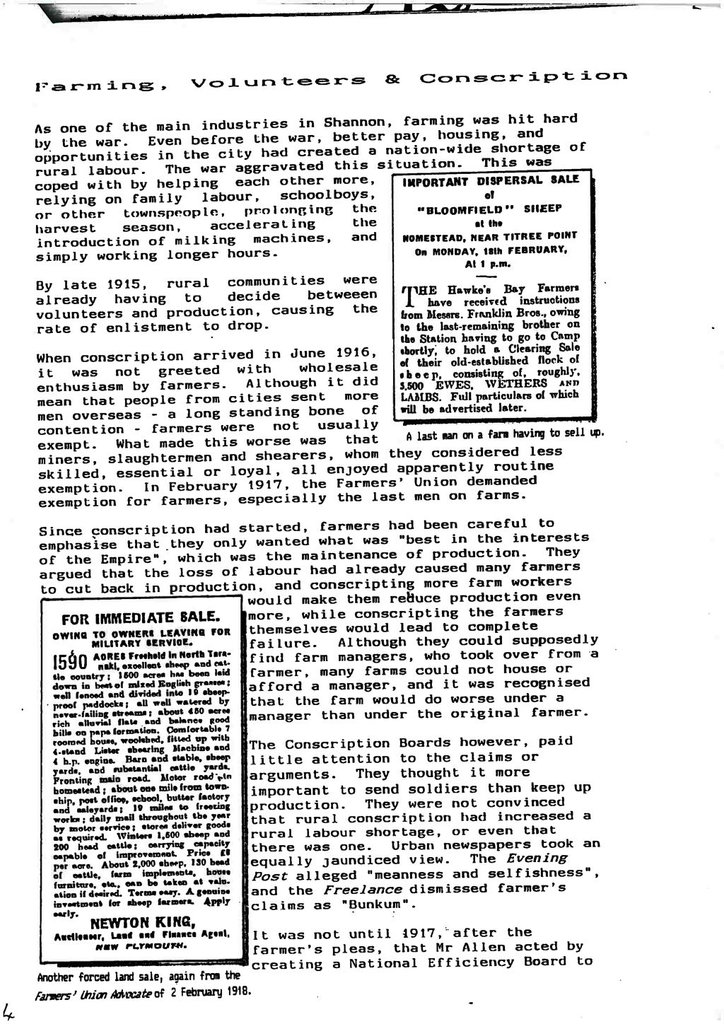
Even before the war, better pay, housing, and opportunities in the city had created a nation-wide shortage of rural labour. The war aggravated this situation. This was coped with by helping each other more, relying on family labour, schoolboys, or other townspeople, prolonging the harvest season, accelerating the introduction of milking machines, and simply working longer hours.
By late 1915, rural communities were already having to decide between volunteers and production, causing the rate of enlistment to drop.
When conscription arrived in June 1916, it was not greeted with wholesale enthusiasm by farmers. Although it did mean that people from cities sent more men overseas - a long standing bone of contention - farmers were not usually exempt. What made this worse was that miners, slaughtermen and shearers, whom they considered less skilled, essential or loyal, all enjoyed apparently routine exemption. In February 1917, the Farmers' Union demanded exemption for farmers, especially the last men on farms.
Since conscription had started, farmers had been careful to emphasise that they only wanted what was "best in the interests of the Empire", which was the maintenance of production. They argued that the loss of labour had already caused many farmers back in production, and conscripting more farm workers
would make them reduce production even more, while conscripting the farmers themselves would lead to complete failure. Although they could supposedly find farm managers, who took over from a farmer, many farms could not house or afford a manager, and it was recognised that the farm would do worse under a manager than under the original farmer.
The Conscription Boards however, paid little attention to the claims or arguments. They thought it more important to send soldiers than keep up production. They were not convinced that rural conscription had increased a rural labour shortage, or even that there was one. Urban newspapers took an equally jaundiced view. The Evening Post alleged "meanness and selfishness", and the Freelance dismissed farmer's claims as "Bunkum".
It was not until 1917, after the farmer's pleas, that Mr Allen acted by creating a National Efficiency Board to help formulate policies applying to production, arid who, on March 16, said that it was not government policy to force a farmer to sell his farm, and that if it couldn't be managed in his absence, he should be exempted. Most Boards welcomed and adhered to these, and other policy statements, and farmers' organisations noted and appreciated the changes.
The main rural discontent was then centered on Boards who seemed to be ignoring the Efficiency Board's directives, and there were complaints that the Boards were a "law unto themselves". For the most part however, rural discontent had died down.
Identification
- Date
- 1989
Related items


Creation
- Created By
- Simon Shuker
Object rights
- License
- Attribution + Noncommercial + ShareAlike
Taxonomy
- Community Tags