Found 28 results

Radio 2ZA- Cinema Advertising Slide

For decades radio 2ZA was a central part of Palmerston North. Founded in 1938 as part of a new and growing network of Government owned commercial stations, 2ZA did radical things like actually naming their announcers (who were anonymous in the non-commercial stations) and even building a personal brand around them in the 1950s. 

This slide continues this personality branding with a photo of 2ZA staff (presumably announcers) beside the station's logo. The 940KHZ frequency dates this slide to before 1978, and the 'Radio New Zealand' logo to after 1975. By the 1980s the 'call sign' frequencies of radio stations ('Z' for commercial, 'YC' for concert, 'YA' for Government non-commercial etc) were phased out in favour of today's numbered frequencies. Before then the lettered callsigns were often printed on radio tuning dials- which worked as long as the frequencies never changed! 

Radio New Zealand's commercial stations were privatized in 1996 and 2ZA (then known as 'Classic Hits') was no exception.  While not a Horowhenua based station, many locals will remember hearing the songs and voices of 2ZA, and the MAVtech Museum in Foxton has some 2ZA equipment on display. 

Rolf Harris Tour- Cinema Advertising Slide

We'll be the first to say that this slide has not aged well. Rolf Harris toured New Zealand in 1970 and this slide may date from this time. It probably screened in Palmerston North but may also have be shown in Levin's cinema as well, given that this was a national tour. We know from the label that it was screened in Kerridge Odeon cinemas- then the biggest chain in New Zealand. Cinema advertising was often used to advertise the arrival of touring acts from overseas.

Rolf Harris was convicted of twelve counts of indecent assault on the 30th of June, 2014. Victims of Harris's offending (outside of the counts he was convicted on) came forward from his 1970 New Zealand tour. 

Cinema Advertising Slide- Saturday Night Fever (GA Version)

1977's 'Saturday Night Fever' was a hit movie in America and in many other countries. However, its foul language, nudity and adult themes meant that it was given an 'adults only' rating which limited who could see it.

So in 1979 Paramount released a 'general audience' edit of the film with the controversial scenes cut and some of the language redubbed. In New Zealand this was given a GA 'General Audience' rating and proved to be just as successful.

It was a busy time for John Travolta- this slide reveals that 'Saturday Night Fever' was being shown as a double billing with 'Grease'- another Travolta film! 

By the late 1970s cinema trends were changing. New Zealanders used to go to the cinema as a social occasion and often picked what they wanted to watch when they got there. But the rise of the Hollywood 'blockbuster' meant that people now went to the cinema to see a particular film. This, and the rise of television, led to a sharp decline in ticket sales. In 1960 the average New Zealand went to 'the flicks' around seventeen times- by 1981 that was only five times and the total number of cinemas went from over 500 down to around 150. Foxton's Coronation Hall was one of these causalities and had ceased to be a regular cinema.

Cinema Announcement Slide- Managerial Announcement

This slide would have been shown by cinema management whenever there was an important announcement to make. Sometimes this might be news of new treats at the food stand. Other times it may have been more serious- like a call for assistance from any doctors in the audience. The projectionist would write on the yellow bar of the slide with removable ink and would rub out the writing after the screening.

There might not seem like much space- but the slide didn't have a lot of time to get the message across. The heat from early carbon- arc projectors would crack the slide in a few seconds so it was displayed and then withdrawn quickly! 

Some cinemas had basic, picture - less 'blank' slides for these announcements, but the cinema who used this one went really fancy!

Cinema Announcement Slide- Damaged Sound Track

This is not the slide you would want to see projected on the screen before your film started! The sound track of analogue films ran beside the images (asides from a few very early, very seldom used systems) so if the sound track was damaged there was little which could be done. Luckily it only impacted a few minutes of footage in this case!

In some cinemas this was more likely to happen. In very early New Zealand cinemas a reel of  short films would move from one operator to the next and if you were the last cinema on the line the images would be worn from all the previous screenings. Some First World War newsreels were played into oblivion and no longer survive (although these did not have sound...)

In the United States of America some theatres host 'second run' screenings of films which have already been used by regular cinemas. These 'discount cinemas' often have films with slight imperfections due to their age (Titanic was screening in these budget theatres six months after its release date!)

1971 Tour of The Great Moscow Circus- Cinema Advertising Slide

In 1971 the circus came to town and with it the great Oleg Popov- a renowned clown who had been touring internationally since 1955. In 1969 Popov was given the title 'People's Artist of the USSR' and was used by the Soviet Union as a goodwill ambassador. 

This tour only visited the main cities of New Zealand- but with the Kerridge Odeon cinema chain being a major sponsor of the tour, this slide would have been shown in the chain's provincial theatres as well. When the Great Moscow Circus returned to Aotearoa in 1974 Kerridge Odeon was still a supporter and was joined by the New Zealand Broadcasting Corporation. 

'Alice, Where Art Thou?' Magic Lantern Slide

Very rarely has such a forlorn scene been so enticing and beautiful. This magic lantern slide is a delicately hand coloured photograph and one of a set used by travelling lanternists who dazzled and entertained in town halls across the world. There was no cheap way of printing colour photography in the 1890s so each slide was done by hand by washing the slide, preparing specially thinned paint (to allow enough light to shine through) and finally coating the results with a protective varnish. 


This slide references a lyric from the popular music hall song ‘Alice, Where Art Thou?’ which was first released in England in 1861. For this particular set of slides a lyric from the song was represented by an image (with the help of ‘Life Models’ who assumed the right poses!) A full set of slides covered the entire song. The lyrics may have fallen into obscurity but the tune remained popular. It was cut on early Edison cylinder recordings and even saw a resurgence as the theme to the 1970s/1980s comedy programme ‘Open All Hours’. But the original words still survive, and they went like this (the slide’s lyrics are in bold)   


“The birds sleeping gently, Sweet Luna gleameth bright, Her rays tinge the forest, And all seems glad tonight, The wind's sighing by me, Cooling my fever'd brow; The stream flows as ever, Yet Alice, where art thou? One year back this even, And thou were by my side, One year back this even, And thou wert by my side. Vowing to love me, One year past this even, And thou wert by my side, Vowing to love me, Alice, what e'er might betide. The silver rain falling, Just as it falleth now, And all things slept gently, Oh! Alice, where art thou? I've sought thee by lakelet, I've sought thee on the hill; And in the pleasant wild-wood, When winds blew cold and chill. I've sought thee in forest, I'm looking heav'nward now, I've sought thee in forest, I'm looking heav'nward now. Oh! there, ‘mid the starshine; I've sought thee in forest, I'm looking heav'nward now, Oh! there amid the starshine, Alice, I know, art thou” 


MAVtech’s slide was made by Bamforth and Company who were based in the English town of Holmfirth. They started making lantern slides in 1883 and later branched out into silent films and seaside postcards. In fact, the firm used some reworked ‘Alice, Where Art Thou?’ designs for some of their postcards! A search of ‘Papers Past’ reveals that the song was often sung in New Zealand shows in the 1890s, with references to its popularity well into the 20th century. By World War Two the ditty was still known enough for a group of British soldiers to name their army lorry ‘Alice’. 


We know that the ‘Alice’ magic lantern show was performed in New Zealand and Manawatu newspapers from the 1880s to the 1900s record lantern shows being given in the name of education, amusement and children’s entertainment. Did ‘Alice’ get shown in Horowhenua? It is very possible!   

Magic Lantern Slide- 'Rocked in the Cradle of the Deep'

 This magic lantern slide is a delicately hand coloured photograph and one of a set used by travelling lanternists who dazzled and entertained in town halls across the world. There was no cheap way of printing colour photography at the time so each slide was done by hand- first by washing the slide, then preparing specially thinned paint (to allow enough light to shine through) and finally coating the results with a protective varnish. Many of these ornate slides illustrated popular music hall songs and religious hymns. This one appears to have been made for ‘Rocked in the Cradle of the Deep’ which first became popular in the mid-19th century.  A full set of slides covered the entire song whose lyrics went like this…. 

Rock’d in the cradle of the deep

I lay me down in peace to sleep;

Secure I rest upon the wave

For thou oh Lord, hast power to save.

I know thou wilt not slight my call,

For thou dost mark the sparrow’s fall!

And calm and peaceful is my sleep

Rock’d in the cradle of the deep,

And clam and peaceful is my sleep

Rock’d in the cradle of the deep. And such the trust that still were mine

Tho’ stormy winds swept o’er the brine.

Or though the tempest’s fiery breath

Roused me from sleep to wreck and death!

In ocean cave still safe with thee,

The germ of immortality;

And calm and peaceful is my sleep

Rock’d in the cradle of the deep,

And calm and peaceful is my sleep

Rock’d in the cradle of the deep   

MAVtech’s slide was made by Bamforth and Company who were based in the English town of Holmfirth. They started making lantern slides in 1883 and later branched out into silent films and seaside postcards.  An online source suggests that this slide was made in 1901. At the time, Major Joseph Perry of the Salvation Army was in the midst of his sensationally popular touring shows which mixed entertainment and a religious service. When they began in the 1890s they consisted of magic lantern performances and live music but Perry later branched out into cinema. He became the most prolific filmmaker in New Zealand at the time. 

There were still some magic lantern shows in 1901 and this popular Christian song would have been perfect for Perry’s tour. Newspapers reveal that Perry did host shows in Palmerston North and Wanganui in 1905, 1906 and 1907- might the slide have been shown there?  

‘Rocked in the Cradle of the Deep’ was a popular song in New Zealand and was sung live at many concerts. Our reliance on shipping (and the high amount of shipwrecks in recent memory) gave the nautical theme even more interest. In Christchurch one rendition in 1897 was backed up with illustrations from a magic lantern. Did another company make a series of slides before Bamforth? Or was this slide made earlier than first thought??  

"The Flight of Ages"- Magic Lantern Slide

 This slide was made in the late 1890s by Bamforth and Company- a firm based in Holmfirth, England. Bamforth began making magic lantern slides in 1883 and later made silent films and seaside postcards.  This slide is exquisite! Such a magnificent slide would have been beyond the purse of most hobbyists and instead it would have been bought by the professional ‘lanternist’ who used the magic lantern projector (powered by limelight, whale oil or carbon arc lamps) to entertain paying customers in halls throughout the world. 

Adding to the entertainment value of these slides, Bamforth often used them to illustrate the lyrics of popular songs. Love ballads and religious songs were especially common. This slide illustrates part of ‘The Flight of Ages’- whose lyrics are below. 

The Flight of Ages

 I heard a song, a tender song, 'Twas sung for me alone,

In the hush of a golden twilight, When all the world was gone ;

And as long as my heart is beating, As long as my eyes have tears,

I shall hear the echces ringing From out the golden years.

I have a rose, a white, white rose. 'Twas given me long ago, When the song had fallen to silence,

And the stars were dim and low ; It lies in an old book faded,

Between the pages white, But the ages cannot dim the dream

It brought to me that night. I have a love, the love of years, Bright as the purest star,

As radiant, sweet, and wonderful, As hopeless and as far;

I have a love, the love of years, It's light alone I see,

And I must worship hope and love, However far it be. It is the love that speaks to me Is that sweet song of old,

It is, the dream of golden years, Those petals white unfold:

And every star may fall from heaven, And every rose decay,

But the ages cannot change my love Or take my dream- or take my dream away.

The slide was part of a numbered set and the lanternist would have ordered them all to match the lyrics sung live by a singer. We know that these lantern shows were popular in the Manawatu in the 1890s and early 1900s before being supplanted by travelling cinemas. In fact, many of New Zealand’s cinema pioneers began their careers with the magic lantern. 

The phrase ‘from life models’ on the slide boasts that these are hand coloured photographs which professional models posed for. Each slide was coloured by hand in Holmfirth, adding to their beauty and their price.  

Cinema Announcement Slide- Coming Attractions

Long before the many-screened multiplexes, people saw films in a 'Picture Palace'. These venues were ornate cinemas with one big screen and usually with multi-level seating. The advent of television and the need to show more films more often saw the end of these wonderful venues. Foxton's MAVtech Museum (located in Coronation Hall) is a picture palace and it still has its 'dress circle' seating.

What could be more palatial than having a medieval herald make an announcement? This slide was shown right before the slides (or short reels) advertising upcoming films (known back then as 'coming attractions')

Foxton Amateur Sports Association Cinema Slide

Cinema advertising slides were usually shown in theatres at the end of the intermission ('God Save The Queen', a newsreel and a sports feature were often featured before the film). But 'advertising' wasn't just for local businesses- local clubs and groups had messages screened alongside official government messages and ads for upcoming features the theatre was screening.

This slide is advertising an athletics day in Foxton's Victoria Park. It dates to around the 1950s/early 1960s and is now a glimpse into what early evening entertainment looked like before television.....

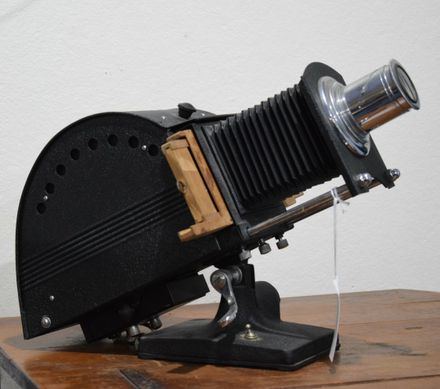
Johnson Optiscope Model 12 Lantern Projector

'Magic Lantern' slides were designed to be projected in a machine like this one. The magic lantern is an early type of optical projector and has been around in some form since the middle of the 17th century. The slides they used had drawings or (from 1849) photographs. Smaller slides became popular in the 1930s and by 1960 the magic lantern was virtually extinct. 

In Victorian times travelling lanternists would give shows in many Horowhenua towns. Sometimes they would be comical but most of the time they were educational- giving views and information about far off lands and new discoveries. By the early 20th century the lanterns were being used by schools, churches and conservation groups. Keen photographers would also make and screen lantern slides of their families.

This particular magic lantern was made in England in the late 1940s- aimed at domestic users or small classrooms and company presentations. Johnson did not design it- they bought the moulds from Ensign whose lantern factory was destroyed during the Blitz. Unlike earlier kerosene powered lanterns, the Optiscope uses a mains powered light bulb.

A range of magic lanterns are on display at Foxton's MAVtech museum of audio and visual technology.


Pantomime - Cinderella, Levin, 1927

Typed on paper glued to back: “Cinderella Pantomime ? – Produced by Miss Myrtle Williams 1927. In De Luxe Theatre (Regent Theatre) Oxford St., Levin. Wedding party, from left – Bridesmaids; June Penny, Celia Ryder, Ivy Pike, Rosie Pike. Page Boy; May Williams (Mrs Howard). Cinderella; Doris Ryder. Prince; Betty Hall.

See story by F.C. Swanwick in Weekly News “Regent Theatre” 26/4/1984.

Copied and donated by Levin Chronicle from the original donated by May Howard. ‘

The pantomime Cinderella, which was performed in the De Luxe Theatre (later the Regent Theatre), Oxford Street, Levin, 1927. The pantomine was produced by Miss Myrtle Williams. In this photograph of the ‘Wedding Party’ those appearing are from left to right:- June Penny, Celia Ryder, Ivy Pike, Rosie Pike, May Williams, Doris Ryder and Betty Hall

1 B&W photo print copy, mounted

See also 2000.448.0001 (duplicate).

Any use of this image must be accompanied by the credit “Horowhenua Historical Society Inc.”

Cast of Children's Play in Fitchetts Hall, Shannon

Written on mounting board below photo with black ink pens, as caption: “Children’s Play in Fitchetts Hall. Shannon.”

Written on back with blue ballpoint pen: “(5) Mrs C.W. Shirriffs Longburn. Phone 82.911 (P.Nth)”

Written on back with black ink: “James Hallam {crossed out and replaced with} J T Bovis Shannon”

Stamped on back with green ink: G.F. FRAMJEE, Photographic Dealer, 18 George Street, Palmerston North. ——Phone 6663.”

Cast of children’s play in Fitchetts Hall, Shannon. In this photograph nineteen unidentified children sit and stand on the stage. All are dressed in costume.

1 B&W photo print, mounted

Any use of this image must be accompanied by the credit “Horowhenua Historical Society Inc.”

Pantomime - Jack and the Beanstalk, Levin, 1928

Typed on paper glued to back: “Jack and the Beanstalk Pantomime. Produced by Myrtle Williams 1928 in the De Luxe Theatre, later called the Regent Theatre (Oxford St.) now demolished. Act 1, Scene 2. The Enchanted Forest. The Ballet of Youth. From left: June Hobson, Beverly Aitken, Eileen Ryder, Betty Hall, Jean Bishop, Gertie Harding.”

Act 1 Scene 2 ’’The Enchanted Forest – The Ballet of Youth” from the pantomine Jack and the Beanstalk, Levin, 1928. Produced by Myrtle Williams this pantomine was held in the De Luxe Theatre (later the Regent Theatre) in Oxford Street. The young women in the photograph are from left to right:- June Hobson, Beverly Aitken, Eileen Ryder, Betty Hall, Jean Bishop and Gertie Harding.

1 B&W photo print copy, mounted

See also 2000.449.0001 (duplicate).

Any use of this image must be accompanied by the credit “Horowhenua Historical Society Inc.”

Shannon Variety Players - "Victorian Music Hall", 1984

Stamped on back with black ink: “N.J. Allan 7 East Road Shannon”

Written on back with blue and black ballpoint pens: “(1)” “36” {crossed out}

Shannon Variety Players – “Victorian Music Hall”, 1984. This photograph shows a group of women in ‘Victorian’ costume. Those in the photograph are from left to right:- Jan Locke, Elizabeth Cole, Jacqui Sayer, Marg August, Midge Jennings, ? Hudson.

1 Colour photo print

Any use of this image must be accompanied by the credit “Horowhenua Historical Society Inc.”

First Operatic show in Regent Theatre, Levin, 1926

Handwritten top of original, as caption – 1926 Handwritten bottom of original, as caption: “First Levin Operatic Show in Regent.”

First Levin Operatic Show in the Regent Theatre, Levin, 1926. Six unidentified women and five unidentified men line up in a formal pose in this photograph.

1 B&W photo print copy, mounted (with 2000.018.0292b)

See also 2000.235.0017 (original) and 2000.235.0014

Any use of this image must be accompanied by the credit “Horowhenua Historical Society Inc.”

Search settings