Found 13 results

'Alice, Where Art Thou?' Magic Lantern Slide

Very rarely has such a forlorn scene been so enticing and beautiful. This magic lantern slide is a delicately hand coloured photograph and one of a set used by travelling lanternists who dazzled and entertained in town halls across the world. There was no cheap way of printing colour photography in the 1890s so each slide was done by hand by washing the slide, preparing specially thinned paint (to allow enough light to shine through) and finally coating the results with a protective varnish. 


This slide references a lyric from the popular music hall song ‘Alice, Where Art Thou?’ which was first released in England in 1861. For this particular set of slides a lyric from the song was represented by an image (with the help of ‘Life Models’ who assumed the right poses!) A full set of slides covered the entire song. The lyrics may have fallen into obscurity but the tune remained popular. It was cut on early Edison cylinder recordings and even saw a resurgence as the theme to the 1970s/1980s comedy programme ‘Open All Hours’. But the original words still survive, and they went like this (the slide’s lyrics are in bold)   


“The birds sleeping gently, Sweet Luna gleameth bright, Her rays tinge the forest, And all seems glad tonight, The wind's sighing by me, Cooling my fever'd brow; The stream flows as ever, Yet Alice, where art thou? One year back this even, And thou were by my side, One year back this even, And thou wert by my side. Vowing to love me, One year past this even, And thou wert by my side, Vowing to love me, Alice, what e'er might betide. The silver rain falling, Just as it falleth now, And all things slept gently, Oh! Alice, where art thou? I've sought thee by lakelet, I've sought thee on the hill; And in the pleasant wild-wood, When winds blew cold and chill. I've sought thee in forest, I'm looking heav'nward now, I've sought thee in forest, I'm looking heav'nward now. Oh! there, ‘mid the starshine; I've sought thee in forest, I'm looking heav'nward now, Oh! there amid the starshine, Alice, I know, art thou” 


MAVtech’s slide was made by Bamforth and Company who were based in the English town of Holmfirth. They started making lantern slides in 1883 and later branched out into silent films and seaside postcards. In fact, the firm used some reworked ‘Alice, Where Art Thou?’ designs for some of their postcards! A search of ‘Papers Past’ reveals that the song was often sung in New Zealand shows in the 1890s, with references to its popularity well into the 20th century. By World War Two the ditty was still known enough for a group of British soldiers to name their army lorry ‘Alice’. 


We know that the ‘Alice’ magic lantern show was performed in New Zealand and Manawatu newspapers from the 1880s to the 1900s record lantern shows being given in the name of education, amusement and children’s entertainment. Did ‘Alice’ get shown in Horowhenua? It is very possible!   

Magic Lantern Slide- 'Rocked in the Cradle of the Deep'

 This magic lantern slide is a delicately hand coloured photograph and one of a set used by travelling lanternists who dazzled and entertained in town halls across the world. There was no cheap way of printing colour photography at the time so each slide was done by hand- first by washing the slide, then preparing specially thinned paint (to allow enough light to shine through) and finally coating the results with a protective varnish. Many of these ornate slides illustrated popular music hall songs and religious hymns. This one appears to have been made for ‘Rocked in the Cradle of the Deep’ which first became popular in the mid-19th century.  A full set of slides covered the entire song whose lyrics went like this…. 

Rock’d in the cradle of the deep

I lay me down in peace to sleep;

Secure I rest upon the wave

For thou oh Lord, hast power to save.

I know thou wilt not slight my call,

For thou dost mark the sparrow’s fall!

And calm and peaceful is my sleep

Rock’d in the cradle of the deep,

And clam and peaceful is my sleep

Rock’d in the cradle of the deep. And such the trust that still were mine

Tho’ stormy winds swept o’er the brine.

Or though the tempest’s fiery breath

Roused me from sleep to wreck and death!

In ocean cave still safe with thee,

The germ of immortality;

And calm and peaceful is my sleep

Rock’d in the cradle of the deep,

And calm and peaceful is my sleep

Rock’d in the cradle of the deep   

MAVtech’s slide was made by Bamforth and Company who were based in the English town of Holmfirth. They started making lantern slides in 1883 and later branched out into silent films and seaside postcards.  An online source suggests that this slide was made in 1901. At the time, Major Joseph Perry of the Salvation Army was in the midst of his sensationally popular touring shows which mixed entertainment and a religious service. When they began in the 1890s they consisted of magic lantern performances and live music but Perry later branched out into cinema. He became the most prolific filmmaker in New Zealand at the time. 

There were still some magic lantern shows in 1901 and this popular Christian song would have been perfect for Perry’s tour. Newspapers reveal that Perry did host shows in Palmerston North and Wanganui in 1905, 1906 and 1907- might the slide have been shown there?  

‘Rocked in the Cradle of the Deep’ was a popular song in New Zealand and was sung live at many concerts. Our reliance on shipping (and the high amount of shipwrecks in recent memory) gave the nautical theme even more interest. In Christchurch one rendition in 1897 was backed up with illustrations from a magic lantern. Did another company make a series of slides before Bamforth? Or was this slide made earlier than first thought??  

"The Flight of Ages"- Magic Lantern Slide

 This slide was made in the late 1890s by Bamforth and Company- a firm based in Holmfirth, England. Bamforth began making magic lantern slides in 1883 and later made silent films and seaside postcards.  This slide is exquisite! Such a magnificent slide would have been beyond the purse of most hobbyists and instead it would have been bought by the professional ‘lanternist’ who used the magic lantern projector (powered by limelight, whale oil or carbon arc lamps) to entertain paying customers in halls throughout the world. 

Adding to the entertainment value of these slides, Bamforth often used them to illustrate the lyrics of popular songs. Love ballads and religious songs were especially common. This slide illustrates part of ‘The Flight of Ages’- whose lyrics are below. 

The Flight of Ages

 I heard a song, a tender song, 'Twas sung for me alone,

In the hush of a golden twilight, When all the world was gone ;

And as long as my heart is beating, As long as my eyes have tears,

I shall hear the echces ringing From out the golden years.

I have a rose, a white, white rose. 'Twas given me long ago, When the song had fallen to silence,

And the stars were dim and low ; It lies in an old book faded,

Between the pages white, But the ages cannot dim the dream

It brought to me that night. I have a love, the love of years, Bright as the purest star,

As radiant, sweet, and wonderful, As hopeless and as far;

I have a love, the love of years, It's light alone I see,

And I must worship hope and love, However far it be. It is the love that speaks to me Is that sweet song of old,

It is, the dream of golden years, Those petals white unfold:

And every star may fall from heaven, And every rose decay,

But the ages cannot change my love Or take my dream- or take my dream away.

The slide was part of a numbered set and the lanternist would have ordered them all to match the lyrics sung live by a singer. We know that these lantern shows were popular in the Manawatu in the 1890s and early 1900s before being supplanted by travelling cinemas. In fact, many of New Zealand’s cinema pioneers began their careers with the magic lantern. 

The phrase ‘from life models’ on the slide boasts that these are hand coloured photographs which professional models posed for. Each slide was coloured by hand in Holmfirth, adding to their beauty and their price.  

Magic Lantern Slide- Family and House

Who are the people in this magic lantern slide? Where is this house? Why is there so much mud? And, most importantly, had anyone heard of firearms safety? The child in the picture must be hoping that the gun isn't loaded.

If anyone can answer these questions (or can decipher the writing on this slide) please let the MAVtech Museum know! In the absence of any answers we can see why this slide is important: many family photographs and postcards show groups outside of houses. With land needing to be broken in, families outside their properties were seen as a kind of colonial pride.

What they are holding also speaks volumes about how people saw themselves (or at least, how they wanted to be seen). The man is holding a gun and is seen as a powerful provider. The boy holds a hammer- has he been helping with the work? The lady holds a book (a Bible perhaps? This was common for womens' photographs in Western countries back then). And the young lady looks ready to go to school or church in her neat hat and tidy clothing. These themes were often used in professional photographs and subconsciously spilled over into many early snapshots. 


Mind you- this could also be a professional photograph.

Also, this is a lantern slide, designed to be projected onto a wall. Unlike a personal photo album, these  slides were usually viewed as a large group. Extended family? A soldier overseas in the First World War? (the Dunedin Photographic Society took photographs of families that soldier relatives could then view near the front. These were all magic lantern slides.)

Photographs are often seen as perfect windows into the past but this one holds more questions than answers! 

Magic Lantern Slide- Unimpressed Cat

The art of the 'silly cat photo' so beloved by the internet dates back to the 1870s. Cats have been seen dressed up in suits (one even had a monocle on!) and were often accompanied by silly captions. 

This cat doesn't look at all pleased to be in it's photograph. As an image it lacks technical polish- the shadow of the photographer intrudes into the image. A hand (soon to be scratched, maybe?) holds the unwilling feline still. The whole thing is overexposed. 

While it wouldn't win any awards, snapshots like this are some of the most pure slices of life ever to be recorded. Even better, it is a magic lantern projector slide- it took effort to make it. So someone, somewhere saw the photo and thought 'that is worth keeping'. 

But it probably wasn't the cat.

Waiata- Be Kind to Animals- Magic Lantern Slide

Every photograph is a window into the past- and sometimes what you see surprises you. Children singing a waiata about being kind to animals seems like a modern day school lesson, but the writing on this slide is from 1924! In the 1920s only a few private schools taught the grammer of Te Reo. Tragically, all the other schools saw speaking Te Reo as a caning offence. Was this slide of one of the private schools- or a smaller group or club? We just don't know.

Or maybe these children were located at Waiata Shores, near Auckland (although even then, few schools used Te Reo names for locations back in the 1920s).

Art historian Walter Benjamin coined a term called 'optical unconsciousness' and part of that is seeing a photograph in hindsight. The people in it do not know the future, but we do. Whatever this photograph depicted it seems like it belongs in our present than in it's past.

But the past is full of surprises!

General Sir Douglas Haig- Magic Lantern Slides

During the First World War when New Zealanders on the 'home front' were far away from the front line and struggled to get accurate photographs published in the press, seeing photos of commanders like Haig would have been important.

Sir Douglas Haig is pictured here after his promotion to General in late 1914 but before his rise to Field Marshal in 1917. A senior commander for much of the war, he has a complicated legacy. Once nicknamed 'the master of the field' and 'the man who won the war' he is now known as 'the butcher of the Somme'- forever linked with the bloody attrition of trench warfare and backward thinking military tactics. However, historians are still divided over which of these legacies is the most deserved.

This 'magic lantern slide' was designed to be inserted into a protector (most likely powered by a lightbulb or, for bigger audiences, a carbon arc lamp) and enlarged onto a screen. Haig's photograph would have been shown in cinemas, schools and churches as well as in community meeting urging patriotism for the war. 

The corner of the slide indicates that it was made in London and it's copies would have served a similar purpose there. 

Magic Lantern Slide- Car and Caravan

Although magic lantern slides were most famously used professionally by schools, universities, churches and lobby groups they were also used by amateur photographers. The glass slides, 'masks' for displaying the image and fixing chemicals could be bought from local photography stores. Anyone with darkroom could have a go.

What makes this slide unusual is that it is in colour- by this stage, most amateurs had abandoned magic lantern slides in favour of smaller, 35mm film. The car's number plates are pre-1964 which gives us an idea of the last date this slide could have been made.

Regardless of how it was captured, this photograph is of a wonderful 'Kiwi' caravan holiday. Where it was taken remains a mystery. 

World War One Army Officer in Gas Mask- Magic Lantern Slide

MAVtech has a broad collection of magic lantern slides- but none are more haunting than this one. We know very little about the person in this photograph. From his uniform we know  he was a lieutenant in the First World War. He is wearing a gas mask to protect against enemy chemical warfare attacks (or 'friendly' gas blowing back towards his own lines). His uniform is clean- it is unlikely he was photographed anywhere near 'The Front'.

It may have been a snapshot. Private cameras on the Western Front were banned from 22nd of December, 1914. One soldier found with a camera was sentenced to three months imprisonment with hard labour. However, the rules were often disobeyed and were sometimes laxer with regards to 'Officers' like a lieutenant. Cameras were also allowed 'behind the lines'  or off-duty, when this picture may have been taken.

But it is more likely that this was an official photograph taken to be displayed during magic lantern lectures at the home front. People were desperate for any news of the war and were eager for photographs. This soldier looks clean, well fed and comparatively relaxed for someone preparing for a chemical attack. He would have been a reassuring image for those back home.

F&R Campbell- Magic Lantern Masks

Chemist shops often sold photographic equipment in the early 20th century- especially in small towns which couldn't support a specialist business. Given that photography meant darkrooms and darkrooms involved chemicals it was a perfect match! The fact that F&R Campbell were opticians made even more sense- snapshot cameras all had lenses after all.....

This is a packet of masks for magic lantern slides. The masks were finely cut pieces of black paper in various shapes such as square, oval, thick boarder etc. The masks were pressed against the glass magic lantern slide to focus the viewer's eyes on the most important, central part of the picture. The lantern would project these images onto a wall.

F&R Campbell were based in Feilding. They were advertising in the local paper in 1914 which would have been around the time these 'Primus' slide masks were made. 

HMS Hood- Magic Lantern Slide

A slide designed to be projected with a 'magic lantern'. The HMS Hood was the biggest warship in the world for much of her service and was the pride of the Royal Navy. Seen as a reminder of the power of Empire, the 'Mighty Hood' visited New Zealand in 1924 and 1936. This photograph was taken during one of these visits.

Slides of the visit would have been viewed around Aotearoa at the time. HMS Hood's 1936 visit was especially important when the warship's presence provided a sense of security as war brewed in Europe. However, the Hood was sunk when fighting the German 'Bismark' in 1941. 

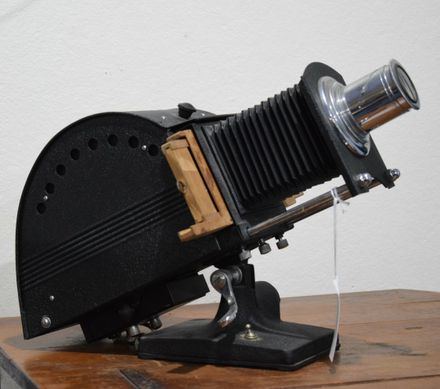
Johnson Optiscope Model 12 Lantern Projector

'Magic Lantern' slides were designed to be projected in a machine like this one. The magic lantern is an early type of optical projector and has been around in some form since the middle of the 17th century. The slides they used had drawings or (from 1849) photographs. Smaller slides became popular in the 1930s and by 1960 the magic lantern was virtually extinct. 

In Victorian times travelling lanternists would give shows in many Horowhenua towns. Sometimes they would be comical but most of the time they were educational- giving views and information about far off lands and new discoveries. By the early 20th century the lanterns were being used by schools, churches and conservation groups. Keen photographers would also make and screen lantern slides of their families.

This particular magic lantern was made in England in the late 1940s- aimed at domestic users or small classrooms and company presentations. Johnson did not design it- they bought the moulds from Ensign whose lantern factory was destroyed during the Blitz. Unlike earlier kerosene powered lanterns, the Optiscope uses a mains powered light bulb.

A range of magic lanterns are on display at Foxton's MAVtech museum of audio and visual technology.


Search settings