Bevan Family Built Fine Homes

Sedgemoor, North Manakau Road was one of these.

Filename: sw2_39-40.pdf ( view | replace description with document text )

Size: 676.1 KB

Document type: application/pdf

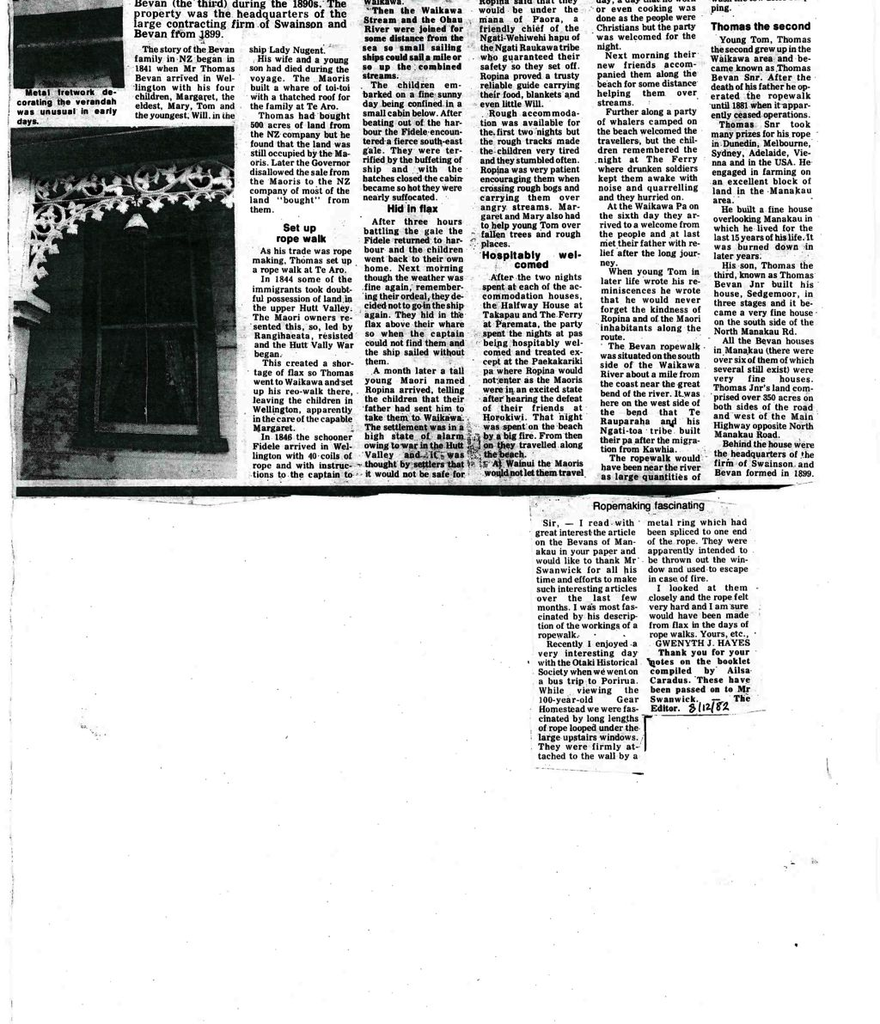
Sedgemoor was built for Mr Thomas Bevan (the third) during the 1890s. The property was the headquarters of the large contracting firm of Swainson and Bevan from 1899.

The story of the Bevan family in NZ began in 1841 when Mr Thomas Bevan arrived in Wellington with his four children, Margaret, the eldest, Mary, Tom and the youngest, Will, in the ship Lady Nugent.

His wife and a young son had died during the voyage.  The Maoris built a whare of toi-toi with a thatched roof for the family at Te Aro.

Thomas had bought 500 acres of land from the NZ Company, but he found that the land was still occupied by the Maoris. Later the Governor disallowed the sale from the Maoris to the NZ Company of most of the land “bought” from them.


Set up rope walk

As his trade was rope making, Thomas set up a rope walk at Te Aro.

In 1844 some of the immigrants took doubtful possession of land in the upper Hutt Valley. The Maori owners resented this, so, led by Rangihaeata, resisted and the Hutt Valley War began.

This created a shortage of flax so Thomas went to Waikawa and set up his rope walk there, leaving the children in Wellington, apparently in the care of the capable Margaret.

In 1846 the schooner Fidele arrived in Wellington with 40 coils of rope and with instructions to the captain to bring the children to Waikawa.

Then the Waikawa Stream and the Ohau River were joined for some distance from the sea so small sailing ships could sail a mile or so up the combined streams.

The children embarked on a fine sunny day being confined in a small cabin below.  After beating out of the harbour the Fidele encountered a fierce south-east gale.  They were terrified by the buffeting of the ship and with the hatches closed, the cabin became so hot they were nearly suffocated.


Hid in flax

After three hours battling the gale the Fidele returned to harbour and the children went back to their own home.  Next morning though, the weather was fine again, and remembering their ordeal, they decided not to go in the ship again.  They hid in the flax above their whare so when the captain could not find them, the ship sailed without them.

A month later a tall young Maori named Ropina arrived, telling the children that their father had sent him to take them to Waikawa.  The settlement was in a high state of alarm owing to war in the Hutt Valley, and it was thought by settlers that it would not be safe for the children to travel, but Ropina said that they would be under the mana of Paora, a friendly chief of the Ngati-Wehiwehi hapu of the Nagat Raukawa tribe who guaranteed their safety so they set off. Ropina proved a trusty reliable guide, carrying their food, blankets and even little Will.

Rough accommodation was available for the first two nights, but the rough tracks made the children very tired and they stumbled often.

Ropina was very patient encouraging them when crossing rough bogs and carrying them over angry streams. Margaret and Mary also had to help young Tom over fallen trees and rough places.


Hospitably welcomed

After the two nights spent at each of the accommodation houses, the Halfway House at Takapau and The Ferry at Paremata, the party spent the nights at pas being hospitably welcomed and treated, except at the Paekakariki pa where Ropina would not enter as the Maoris where in an excited state after hearing the defeat of their friends at Horokiwi.  That night was spent on the beach by a big fire. From then on they travelled along the beach.

At Wainui the Maoris would not let them travel further as it was a Sunday, a day that no work or even cooking was done as the people were Christians, but the party was welcomed for the night.

Next morning their new friends accompanied them along the beach for some distance helping them over streams.

Further along a party of whalers camped on the beach welcomed the travellers, but the children remembered the night at The Ferry where drunken soldiers kept them awake with noise and quarrelling and they hurried on.

At the Waikawa Pa on the sixth day they arrived to a welcome from the people, and at last met their father with relief after the long journey.

When young Tom in later life wrote his reminiscences he wrote that he would never forget the kindness of Ropina and of the Maori inhabitants along the route.

The Bevan ropewalk was situated on the south side of the Waikawa River about a mile from the coast near the great bend of the river.  It was here on the west side of the bend that Te Rauparaha and his Ngati-toa tribe built their pa after the migration from Kawhia.

The ropewalk would have been near the river as large quantities of water were needed to wash the tow after stripping.


Thomas the second

Young Tom, Thomas the second grew up in the Waikawa area and became known as Thomas Bevan Snr. After the death of his father he operated the ropewalk until 1881 when it apparently ceased operations.

Thomas Snr took many prizes for his rope in Dunedin, Melbourne, Sydney, Adelaide, Vienna and in the USA.  He engaged in farming on an excellent block of land in the Manakau area.

He built a fine house overlooking Manakau in which he lived for the last 15 years of his life. It was burned down in later years.

His son, Thomas the third, known as Thomas Bevan Jnr, built his house, Sedgemoor, in three stages, and it became a very fine house on the south side of the North Manakau Rd.

All the Bevan houses in Manakau (there were over six of them of which several still exist) were very fine houses. Thomas Jnr’s land comprised over 350 acres on both sides of the road and west of the Main Highway opposite North Manakau Road.

Behind the house were the headquarters of the firm of Swainson and Bevan formed in 1899.  Thomas went into partnership with Mr Swainson.


Business was vast

The business was vast even from modern days of the type it was and it had very varied interests.

The complex housed a blacksmith, sawing shop for cutting timber from flitches, required for operations, stables with stalls for 40 horses, harness and feed shed and office and other ancillary buildings. Most of these are gone now.

Also, there was an engineering workshop. They manufactured horse vehicles especially utility vehicles.

The method of putting the iron tyres on the wooden wheels is interesting. The wheel was placed in a shallow tank. The tyre was heated red hot in the forge. This was a coke fire with large bellows creating a powerful draught creating an intense heat. The tyre was lifted by up to three men if it was a large tyre and quickly placed over the rim of the wheel, the rim being of hard jarrah which did not burn easily. Immediately the tank was flooded from an overhead tank of water, cooling the tyre and shrinking it onto the rim.


Largest lathe

The then largest lathe in NZ which was still in use at cables in Wellington in the 1930s was in the workshop. Amongst the purposes this lathe was put to  was the threading of steel rods two inches thick and nuts four inches wide. These were used to tighten the cables of suspension bridges in the Otaki Gorge and the Levin Pipe Bridge. Four feet long spanners were used to tighten the nuts.

Up to 50 horses were used in the firms operations and it even had traction engines in their stables. Heavy carting was done.  A photo exists of an engine with three four-wheeled wagons in tow crossing the Ohau River, probably loaded with shingle.

Land cultivation ploughing, harrowing, seeding etc was done. The engines would have been an excellent means of dragging out the myriads of stumps and logs that littered the land then.

Reaping and binding of oat crops, threshing of grain and cutting of chaff was done by engines. If the farmer’s credit was doubtful a proportion of chaff was taken as payment.

Metalling of roads and putting groynes in rivers was also done. The firm was reputed to have the first hay baler in the North Island.  Lorries were also used for carting.

Flaxmilling was also engaged in, with a mill on the south side of the Waikawa River between the railway and road bridges. Flax was cut and carried by rail from Plimmerton to Tokomaru. Flax would have been cut by contract at a price per tram trolley.

I can remember seeing flax being carried by railtrucks and lorries passing the Beach Rd intersection from about 1916 into the 1920s, but to which flax mill I don’t know. The number of workers employed was from 50 to over one hundred probably the latter figure being when flax tow prices were high. Prices for tow fluctuated very much over the years from high to an unproductive level.

In 1904 one of their tractor engines dragged the one-roomed school from Beach Rd to be the nucleus of the north block of Levin School. A photo exists of it passing the Weraroa Reserve.


Brawny arms needed for making rope

The walk would be from 600 feet to 1200 feet covered in, at least overhead, and almost certainly would be of thatch of native materials and of narrow proportions.

First the flax tow would be carded.  A multi spinning wheel was used.  A large wheel with a semi-circular frame above with up to twelve small rollers like cotton reels with a wire hook fastened through the centre were fastened to the frame, so that the rollers were inside and the hooks outside.

A band on the wheel revolved the rollers so that the hooks twisted when a handle was turned by hand. Strands of tow were tied to the hooks.

A worker with a bundle of tow around his body with the loop of the bundle to the front walked backwards feeding the tow with his left hand to his right hand with his fingers forming the yarn as in hand wool spinning.  Hooks on overhead cross arms kept the various spinners' yarns apart.

When the required length of yarn had been spun it was wound onto a reel with the spinner walking forward keeping hold of the end so that the yarn did not untwist.

The yarn was then untwisted and respun in the opposite direction so as to make the twist permanent. The yarns were then twisted into strands.

A set of three winches (simple two gear) with hooks on the top gears was at the head of the walk. Three yarns were tied to each head.  Each set of three yarns were led to the end of the walk and tied to hooks on a two wheeled sledge which was loaded with weights.

As the winches were turned the yarns twisted into strands in the opposite direction of the original twist. The twisting shortened the length and so at intervals weights were dropped off.  The sledge kept everything taut as the shortening dragged the sledge along.

The strands were then twisted into rope. Sets of three strands were fastened onto hooks in a tackle board at the head and onto hooks on the sledge at the end of the walk. The strands were looped over hooks on overhead beams and the sledge pulled back until the strands were taut. Up to three ropes could be made at once according to the thickness.

The strands were placed in grooves of a cone section of wood the thin end allowing the three strands to be tied to the hooks.  The sledge was pulled back tightening the strands.

A similar top was at the head. The tops had woolders (double handles) through them so as the tops could be turned.

As the twisting of the tops proceeded at both ends the tops were forced along as the strands were twisted into rope behind the tops.  The twisting shortened the length dragging the sledge forward and the weight on the sledge was diminished by dropping off weights at intervals.

When making 12 inch circumference ropes, three tons of weights were used at the beginning. To ease the work, tops were inserted at intervals and twisted. The workers must have had brawny arms then.

There were variations in rope making, such as the number of strands used and plaiting for soft ropes.

  • Created by: Pippa
  • Last Edited by: ruth
  • Last Edited: 09/11/2007 23:14

Discuss This Topic

There are 0 comments in this discussion.

join this discussion

Tags

Tags: Corrie Swanwick

Bevan Family Built Fine Homes


Creator:Corrie Swanwick
Creation date:01/12/1982
Publisher:The News