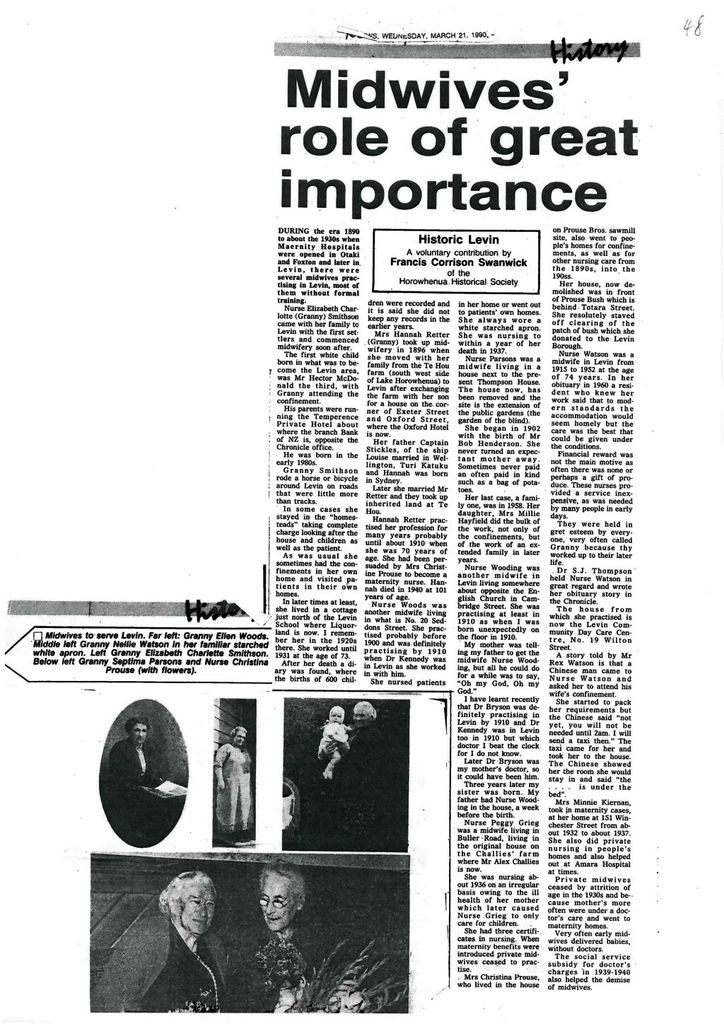
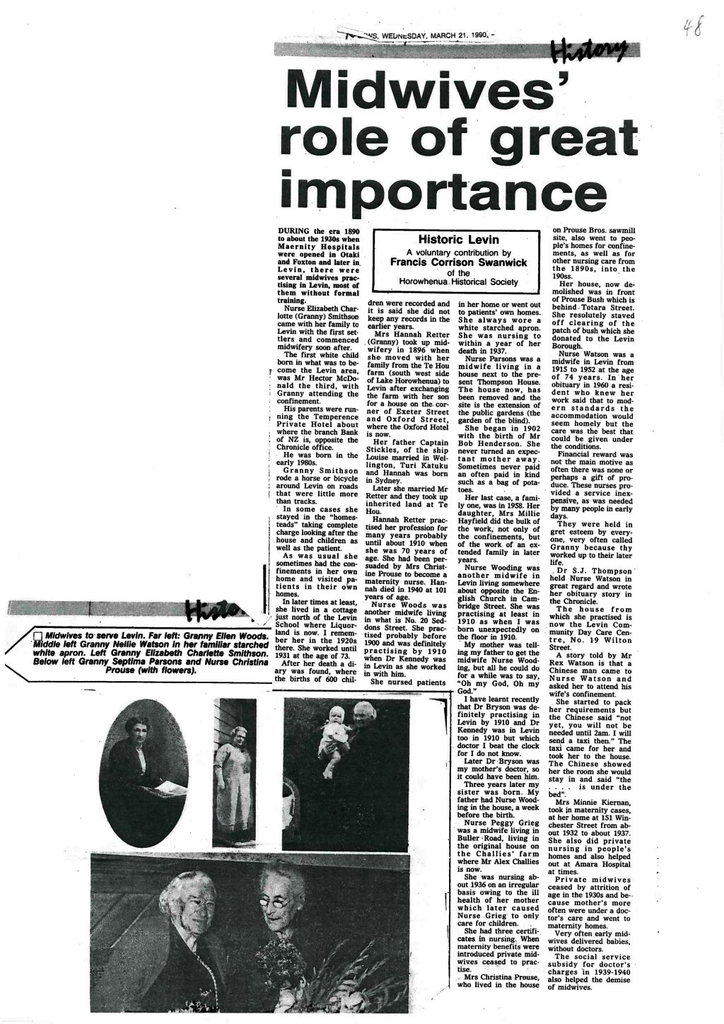

Granny Smithson
Nurse Elizabeth Charlotte (Granny) Smithson came with her family to Levin with the first settlers and commenced midwifery soon after.
The first white child born in what was to become the Levin area was Mr Hector McDonald the third, with Granny attending the confinement.
His parents were running the Temperance Private Hotel, about where the branch Bank of NZ is, opposite the Chronicle office.
He was born in the early 1890s.
Granny Smithson rode a horse or bicycle around Levin on roads that were little more than tracks. In some cases she stayed in the “homesteads” taking complete charge, looking after the house and children as well as the patient.
As was usual she sometimes had the confinements in her own home and visited patients in their own homes.
In later times at least, she lived in a cottage just north of the Levin School where Liquor land is now. I remember her in the 1920s there.She worked until 1931 at the age of 73.
After her death a diary was found, where the births of 600 children were recorded and it is said she did not keep any records in the earlier years.
 Granny Retter
Mrs Hannah Retter (Granny) took up midwifery in 1896 when she moved with her family from the Te Hou farm (south west side of Lake Horowhenua) to Levin after exchanging the farm with her son for a house on the corner of Exeter Street and Oxford Street, where the Oxford Hotel is now.
Her father Captain Stickles, of the ship Louise married in Wellington, Turi Katuku and Hannah was born in Sydney.
Later she married Mr Retter and they took up inherited land at Te Hou.
Hannah Retter practised her profession for many years probably until about 1910 when she was 70 years of age. She had been persuaded by Mrs Christine Prouse to become a maternity nurse. Hannah died in 1940 at 101 years of age. Photo (left above) shows Hana Retter on her 100th birthday.
Nurse Woods

 Nurse Woods was another midwife living in what is No. 20 Seddon Street.
[Editor's note: We have been advised that the address was actually
22 Seddon Street - 24 April 2014]
- The 1917-1918 Rates Book lists a Mrs Bignell at 44 Seddon Street, Levin - was this our midwife???
Note: Also we have been informed that Levin renumbered the houses in its streets - this may further complicate the confusion.
She practised probably before 1900 and was definitely practising by 1910 when Dr Kennedy was in Levin as she worked in with him.
She nursed patients in her home or went out to patients’ own homes.She always wore a white starched apron.She was nursing to within a year of her death in 1937.
 Nurse Parsons
Photo on left: Nurse Parsons (on left) aged 82, with Mrs R. Prouse (on right) aged 91 years - taken February 1st 1951.
Nurse Parsons was a midwife living in a house next to the present Thompson House. The house now has been removed and the site is the extension of the public gardens (garden of the blind).
She began in 1902 with the birth of Mr Bob Henderson.She never turned an expectant mother away.Sometimes never paid and often paid in kind,such as a bag of potatoes.
Her last case, a family one, was in 1958.Her daughter, Mrs Millie Hayfield did the bulk of the work, not only of the confinements, but of the work of an extended family in later years.
Nurse Wooding
Nurse Wooding was another midwife in Levin living somewhere about opposite the English Church in Cambridge Street - possibly at 14 Manchester Street - a house built for a Mary Wooding in 1906. She was practising at least in 1910 as when I was born unexpectedly on the floor in 1910.

My mother was telling my father to get the midwife Nurse Wooding, but all he could do for a while was to say “Oh my God, Oh my God.”
I have learnt recently that Dr Bryson was definitely practising in Levin by 1910 and Dr Kennedy was in Levin too in 1910, but which doctor I beat the clock for I do not know.
Later Dr Bryson was my mother’s doctor, so it could have been him.
Three years later my sister was born. My father had Nurse Wooding in the house, a week before the birth.
Levin Private Hospital [contributed by P Coard May 2015]:
On 20 October 1911, The Levin Private Hospital in Essex Street, for "medical, surgical and maternity cases" with Nurse Dustow "late of St Helen's Hospital, Wellington and Private Hospital, Hastings".
The Chronicle of 17 October 1911 reported that Nurse Dustow had opened a private hospital in Levin - having taken over the residence of Mr Blythe".
In the Chronicle of 5 January 1912, it is reported that in recent times Levin has acquired a private hispital "on the hill behind Dr Davies" complete with an operating room.
In April 1912 the Levin Borough Council received a letter from Nurse Dustow requesting better lighting at the intersection of Exeter and Bristol Streets for patients arriving at night from the country. The request was granted.
On 2 October 1912 Nurse Dustow's Bristol Street house and all its contents were advertised for sale as she was "leaving town".
In May to July 1913 advertisements in the Chronicle announced that Nurse Wilson had taken over Nurse Dustow's Private Hospital, Bristol Street.
in the Chronicle of 16 December 1915, Nurse Wilson "who for some time conducted a private hospital in Levin" is reported to be on the staff of a British Military hospital in Gibraltar.
In September 1920 The Levin Private Hospital was in Queen Street, Levin with R. Harris as Matron-in-charge.
Births continued at the Levin Private Hospital with notices in the newspaper in 1924, 1925, 1930 and 1932; also the death of Dr. Hunter in 1927. It appears the hospital may have closed about September 1932 as the last birth notice found is on 12 September 1932,
Nurse Peggy Grieg
Nurse Peggy Grieg was a midwife living in Buller Road, living in the original house on the Challies’ farm where Mr Alex Challies is now.
She was nursing about 1936 on an irregular basis owing to the ill health of her mother, which later caused Nurse Grieg to only care for children.
She had three certificates in nursing. When maternity benefits were introduced private midwives ceased to practise.
Mrs Christina Prouse
Mrs Christina Prouse, who lived in the house on Prouse Bros. sawmill site, also went to people’s homes for confinements, as well as for other nursing care from the 1890s, into the 1900s.
Her house, now demolished was in front of Prouse Bush, which is behind Totara Street.She resolutely staved off clearing of the patch of bush which she donated to the Levin Borough.
Nurse Watson
Nurse Watson was a midwife in Levin from 1915 to 1952 at the age of 74 years. In her obituary in 1960 a resident who knew her work said that to modern standards the accommodation would seem homely, but the care was the best that could be given under the conditions.
Financial reward was not the main motive as often there was none or perhaps a gift of produce.These nurses provided an inexpensive service, as was needed by many people in early days.
They were held in great esteem by everyone, very often called Granny because they worked up to their later life.
Dr S.J. Thompson held Nurse Watson in great regard and wrote her obituary story in the Chronicle.
The house from which she practised is now the Levin Community Day Care Centre, no 19 Wilton Street.
A story told by Mr Rex Watson is that a Chinese man came to Nurse Watson and asked her to attend his wife’s confinement.
She started to pack her requirements but the Chinese said “not yet, you will not be needed until 2am.I will send a taxi then.” The taxi came for her and took her to the house. The Chinese showed her the room she would stay in and said “the ……… is under the bed.”
Nurse Ashmore [added by P. Coard May 2015]
I have found an advertisement in 1916 for "Nurse Ashmore,Certified and Traines Ladies' Nurse in Cambridge Street"
and also a reference in Tony Hunt's book Foxton 1888-1988 to:
"Nurse Ashmore [who] established her Kia Ora Maternity Home in 1917" in Foxton.
Mrs Minnie Kiernan, took in maternity cases, at her home at 151 Winchester Street from about 1932 to about 1937. She also did private nursing in people’s homes and also helped out at Amara Hospital at times.
Private midwives ceased by attrition of age in the 1930s and because mothers more often were under a doctor’s care and went to maternity homes.
Very often early midwives delivered babies, without doctors.
The social service subsidy for doctor’s charges in 1939-1940 also helped the demise of midwives.
The News, March 21, 1990
Shannon [contributed by P. Coard May 2015]
On 18 June 1913, the Chronicle reported that a maternity home is to be opened in Shannon by Nurse Hawkes late of Queen Charlotte's Hospital, London, England - located in Vance Street, Shannon, its name was Benbrook.